

Oregon requires drivers to carry liability insurance, but the minimum limits required by law may be far less than the damage caused by a significant injury. If the driver who caused the accident carries only Oregon minimum coverage limits, you may find yourself facing medical bills, lost income or wage loss, and other losses that exceed the available insurance coverage.
Understanding your options can make a significant difference in your recovery.
Oregon’s Minimum Liability Auto Insurance Requirements
Oregon law currently requires most drivers to carry at least:
- $25,000 for bodily injury to one person
- $50,000 for bodily injury to two or more people in a single accident
- $20,000 for property damage
At first glance, those limits may sound sufficient in some cases. In reality, they can be exhausted very quickly. A single emergency room visit, ambulance transport, diagnostic imaging, physical therapy, and a few weeks of missed work can easily exceed $25,000.
For more serious injuries, medical expenses alone may reach hundreds of thousands of dollars. And that doesn’t begin to consider income loss.
An Example
Imagine you are rear-ended by a distracted driver. As a result, you suffer:
- A herniated disc
- Months of physical therapy
- Lost wages during recovery
- Ongoing pain and limitations
Your total out-of-pocket expenses may exceed $100,000.
If the at-fault driver carries only Oregon’s minimum bodily injury coverage of $25,000, that insurance company may pay its entire policy limit and still leave a substantial portion of your damages unpaid.
What happens then?
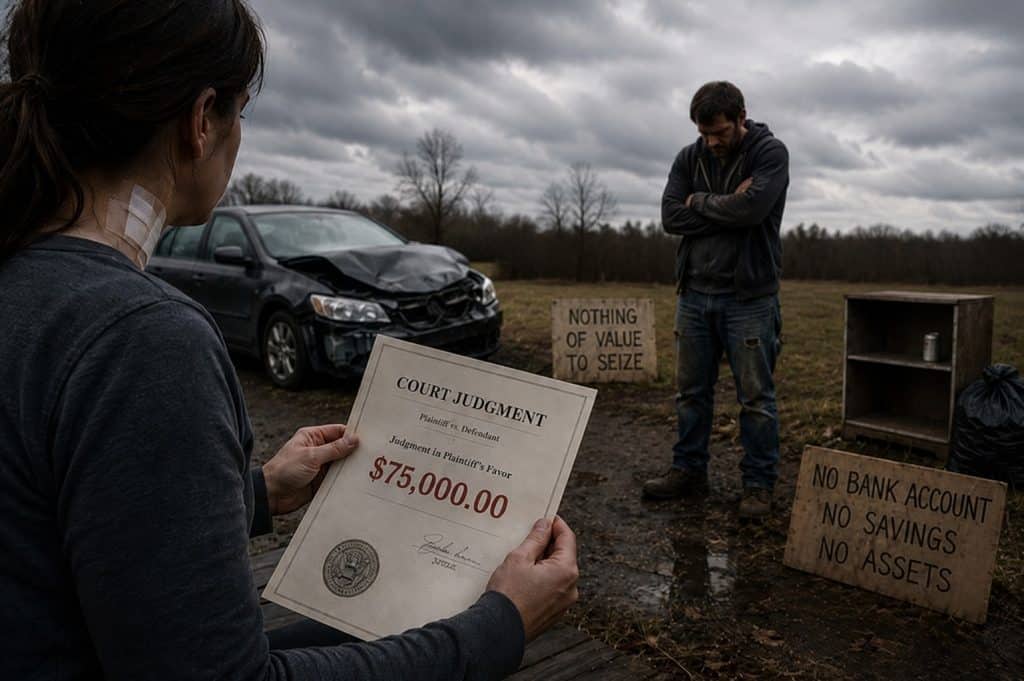
The Problem With Suing the At-Fault Driver Personally
Many people assume they can simply sue the driver who caused the accident. While that is technically true, the reality is often more complicated.
Even if you obtain a judgment against the at-fault driver, collecting additional compensation may be difficult or impossible. The financial resources used in suing the at fault driver will often result in more expenses you will not be reimbursed for. Getting a judgment, and collecting on a judgment, are not the same thing. A court judgment does not automatically result in payment.
In some cases, a skilled lawyer may be able to negotiate both the policy limits and a smaller amount from the driver. Whether that is possible depends on the specific facts of the case, including whether the driver has assets or other resources available to satisfy a claim.
As a practical matter, an insurance policy is often the primary source of compensation after an accident. That is why looking for other forms of insurance becomes critically important.
Understanding Underinsured Motorist Coverage (UIM)
Every Oregon driver that has liability coverage also has Underinsured Motorist Coverage, commonly referred to as UIM. That’s the law. UIM coverage is designed to protect you when the at-fault driver’s insurance is insufficient to fully compensate you for your injuries.
In simple terms, UIM coverage may allow you to seek compensation from your own insurance company after the at-fault driver’s policy limits have been exhausted.
Many people are surprised to learn that they may need to pursue a claim against their own insurance company despite not causing the accident.
A Simple UIM Example
Assume:
- Your damages total $150,000
- The at-fault driver has a $25,000 bodily injury policy
- You carry $100,000 in UIM coverage
The at-fault driver’s insurance company pays its $25,000 limit. You may then be entitled to pursue additional compensation through your own UIM coverage.
The exact amount available depends on numerous factors, including policy language and Oregon law, but UIM coverage can provide a critical source of compensation recovery when the at-fault driver’s insurance is inadequate. However, there are certain procedural steps that must be followed to pursue a UIM claim, so it’s best to consult with a personal injury lawyer before settling with the at-fault driver for the policy limits.
Don’t Assume Your Insurance Company Is Automatically on Your Side
Many people believe that because they have faithfully paid premiums for years, their own insurance company will automatically pay the full value of a UIM claim. Unfortunately, UIM claims are often disputed.
Insurance companies may argue:
- Your injuries are not as serious as claimed
- Medical treatment was unnecessary
- Your symptoms were caused by a pre-existing condition
- Future medical care is not needed
- You were partially at fault for the accident
In many respects, a UIM claim can become just as contentious as a claim against the at-fault driver’s insurance company.
Why Early Investigation Matters
Determining the available insurance coverage is one of the most important steps following a serious accident.
An attorney can help:
- Identify all available insurance policies
- Determine whether UIM coverage exists and whether more than one UIM policy may be available to you
- Evaluate policy limits
- Preserve important evidence
- Protect your rights during settlement negotiations
Waiting too long can make it more difficult to investigate the claim and maximize available recovery.
Steps to Take After a Serious Accident
If you suspect the at-fault driver may have limited insurance coverage:
- Seek Medical Treatment
Your health should always come first.
- Follow Your Doctor’s Recommendations
Gaps or delays in treatment can create challenges later in the claim process.
- Notify Your Insurance Company
Many policies require prompt notice of a potential UIM claim.
- Avoid Accepting a Settlement Too Quickly
Once certain agreements are signed, important rights may be affected.
- Speak With an Attorney
Serious injury claims involving limited insurance coverage often require careful analysis of all available sources of compensation. Too many times, victims leave money on the table because they don’t understand the process or know where to look.
Let Us Fight For You.
The decisions you make during the first few weeks after an accident can significantly affect the value of your claim.
At Shlesinger & deVilleneuve Attorneys, P.C., we have spent decades helping thousands of injured Oregonians stand up to insurance companies.
If you have questions about your rights after an accident, contact us for a free consultation. We can evaluate your claim, explain your options, and help level the playing field against the insurance company.
Let Us Fight For You.